THE FUSION COMMAND LINEthe outcomes that must be achieved.Fusion Command is Fusion's product line for operations. Command CRM, Command Accounting, Command MCR, and Command DPS connect customers, accounts, responsibilities, documents, media, approvals, schedules, and evidence to measurable results, so teams can see what must happen, what is happening, and what has been achieved.COMMAND CRM · COMMAND ACCOUNTING · COMMAND MCR · COMMAND DPS · WORKFLOWS · OUTCOMES · EVIDENCEExplore CommandUnderstand outcomes● ● ● COMMAND MCR / COMMAND CENTERCRM · ACCOUNTING · MCR · DPSOUTCOMES · EVIDENCE · APPROVALSCommand CRM ✦ Command Accounting ✦ Command MCR ✦ Command DPS ✦ Outcomes ✦ Workflows ✦ Approvals ✦ Evidence ✦ Schedules ✦ Documents ✦ Media operations ✦ Automation ✦Command CRM ✦ Command Accounting ✦ Command MCR ✦ Command DPS ✦ Outcomes ✦ Workflows ✦ Approvals ✦ Evidence ✦ Schedules ✦ Documents ✦ Media operations ✦ Automation ✦
Four Command products. One way to run the work.
01 / THE COMMAND LINEEach Command product focuses on one kind of work and shares identity, documents, workflows, permissions, and evidence with the others.
Command CRM
01 / CUSTOMERSCRM means Customer Relationship Management. Connect the complete customer relationship to opportunities, agreements, service, communications, obligations, workflows, and outcomes.Explore Command CRM →
Command Accounting
02 / ACCOUNTINGDouble-entry accounting with exact amounts: a general ledger, sales and purchases, banking, and financial reports, as a full accounting application and as the accounting module of Command CRM. In development.Explore Command Accounting →
Command MCR
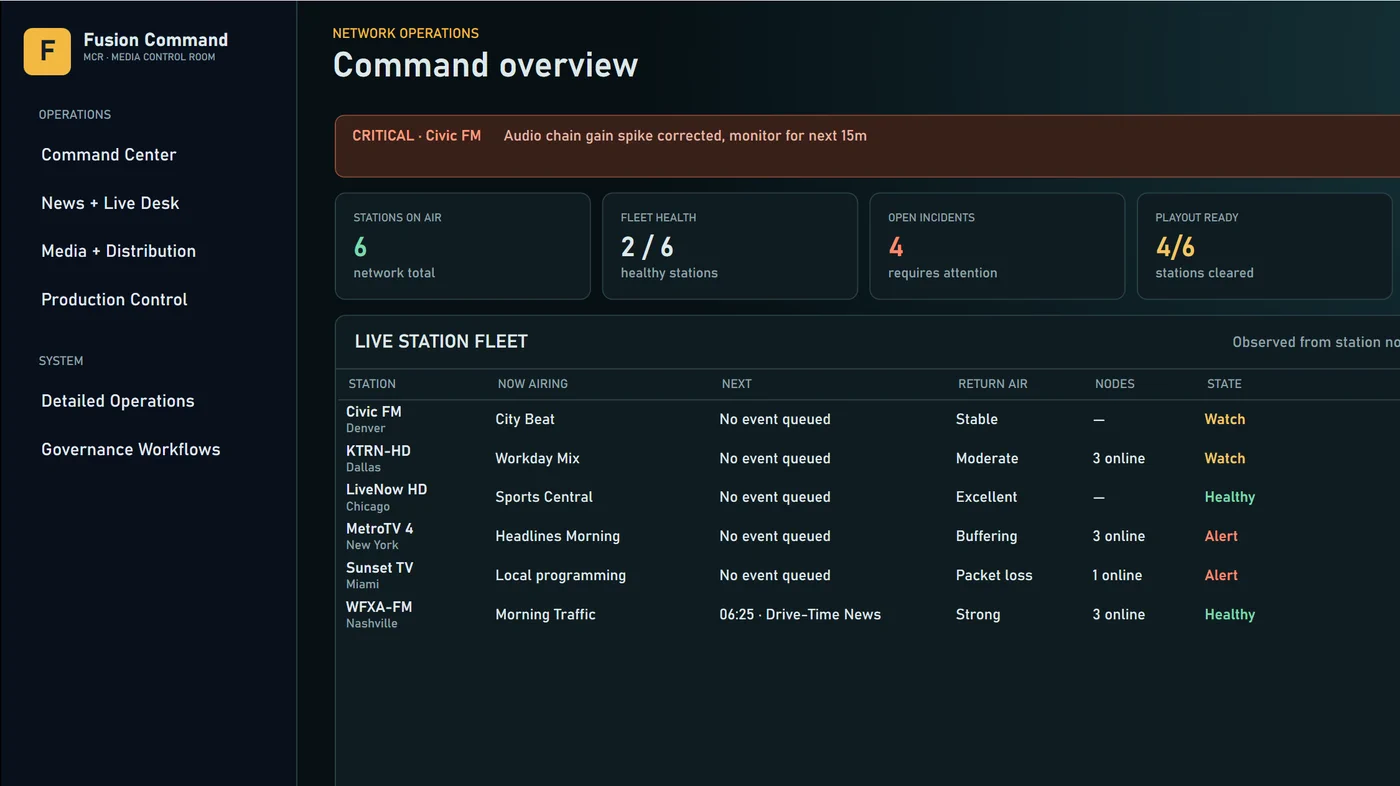
03 / MEDIAMCR means Media Control Room. Coordinate stations, schedules, campaigns, rundowns, newsroom activity, playout readiness, incidents, and broadcast health from one operational view.Explore Command MCR →
Command DPS
04 / DOCUMENTSDPS means Document Processing Server. Create, receive, classify, route, sign, verify, transform, and connect documents to real workflows and governed outcomes.Visit Command DPS →
Workflows describe the path. Outcomes define success.
02 / OUTCOMESA workflow coordinates the people, systems, approvals, documents, and actions involved in work. An outcome defines the result that must be realized. Command connects both: it adapts the path as conditions change while preserving ownership, evidence, policy, and a clear definition of completion.
Define.
01Declare the result, responsible parties, constraints, milestones, measures, and required evidence.
Guide.
02Coordinate workflows, decisions, communications, automation, and exceptions around the desired result.
Prove.
03Verify completion through documents, records, signatures, media, measurements, and auditable history.
Command CRM turns the customer record into an operating context.
03 / COMMAND CRMCommand CRM brings the relationship, the work, and the result into the same governed context instead of leaving teams to reconcile disconnected contact records, task lists, inboxes, documents, and reports.
Relationship context
CONNECTConnect people, organizations, agreements, inventory, opportunities, service history, communications, documents, and current obligations to one understandable customer view.
Operational ownership
ASSIGNAssign accountable people, departments, permissions, due dates, approvals, follow-ups, and exception paths so work has an owner and a visible next action.
Measurable completion
COMPLETEDefine what done means, collect the required evidence, measure progress and risk, and preserve the decisions that support the final outcome.
Every team gets its own view without splitting the record.
04 / ROLESSales, service, management, finance, purchasing, inventory, fulfillment, transportation, hospitality, security, and customer-facing portals work from role-specific views while sharing governed records and activity history.
Department workspaces
TEAMSGive each team focused queues, dashboards, forms, searches, and actions while preserving shared customer, document, task, and outcome relationships.
Management oversight
MANAGERSSee workload, overdue work, exceptions, readiness, approvals, financial and service indicators, and the evidence behind each status instead of relying on a separate reporting copy.
Customer and partner portals
CUSTOMERS · PARTNERSExpose bounded portals for messages, requests, documents, approvals, vouchers, statements, service updates, and other interactions without opening internal operational authority.
Permissions, activity, and evidence travel with the work.
05 / GOVERNANCECommand applies authorization at the action boundary, records meaningful operational activity, and keeps protected documents and workflow evidence connected to the records they support.
Role and action permissions
01Keep read access, administrative oversight, and consequential changes distinct. Permissions are granted deliberately, without silently widening operational authority.
Shared activity history
02Record status changes, assignments, approvals, communications, document events, and other material actions in a history that can be traced across related work.
Exceptions and readiness
03Surface blocked, overdue, incomplete, or risky work with the responsible record and the evidence required, so teams can correct the condition rather than only acknowledge an alert.
Intelligence you can inspect
04Use Solerra, programmable nodes, and AI-assisted analysis to classify information, recommend actions, surface risk, and automate repeatable work. People keep visible rules, editable decisions, evidence, and control over consequential outcomes.
It still works when the internet does not.
06 / LOCAL FIRSTRun Command on Fusion Web Server, Fusion OS, or connected infrastructure. Local applications keep essential workflows, data, permissions, rules, and automation near the people doing the work, then synchronize governed changes when connections are available.